
EpiCypher CUTANA™ CUT&Tag Kit促销活动
EpiCypher CUTANA™ CUT&Tag Kit,为组蛋白翻译后修饰(PTM)的超灵敏定位提供了全面的解决方案,帮助研究人员以更低的测序成本、更低的细胞用量和更高的信噪比来分析组蛋白翻译后修饰。EpiCypher特别推出促销活动,凡订购CUTANA™ CUT&Tag Kit即可享受额外15%折扣优惠!
促销代码:CTK15
促销产品信息:
全新产品货号 | 产品名称 | 规格 | 旧货号 |
14-1102-48s1 | CUTANA™ CUT&Tag Kit with Primer Set 1 | 48 Reactions | 14-1102 |
14-1102-48s2 | CUTANA™ CUT&Tag Kit with Primer Set 2 | 48 Reactions | 14-1103 |
14-1102-24s3 | CUTANA™ CUT&Tag Kit with Primer Set 1 Subset | 24 Reactions |

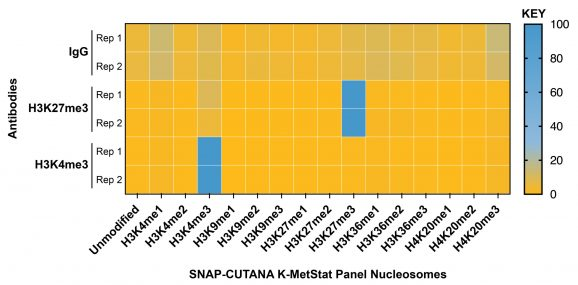
CUTANA™ CUT&Tag试剂盒为组蛋白翻译后修饰 (PTM) 的超灵敏图谱绘制提供了全面的解决方案(Kaya-Okur et al.,2019)。该试剂盒共 48 个反应,使用专有的Direct-to-PCR策略,在一个管中完成从细胞到 PCR 扩增测序文库的整个过程,跳过了传统的文库预处理,最大程度地减少了样品损失(Kaya-Okur et al.,2020)。并且与多道移液器兼容,提高了通量和可重复性。阳性(H3K27me3 和 H3K4me3)和阴性(IgG)对照抗体与 SNAP-CUTANA™ K-MetStat Panel 核糖体掺入对照(图2)配对,以持续监控实验流程并指导故障排除。
CUT&Tag的推荐输入量是每个反应100,000个原生核。可比较的数据低至10,000个细胞核,并且该方案也可用于整个细胞、冷冻保存样本和轻度交联的细胞核或细胞进行验证。CUT&Tag为组蛋白 PTMs 提供了强大的分析功能。对于染色质相关蛋白(如转录因子),建议使用CUTANATM CUT&RUN (EpiCypher 14-1048,EpiCypher 14-1001/14-1002)。
相关数据
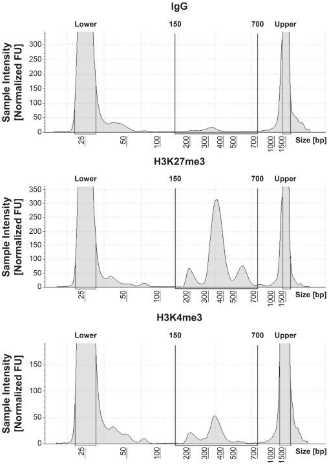
| Figure 1: CUT&Tag DNA fragment size distribution analysis |
CUT&Tag was performed as described in Figure 5. Library DNA was analyzed by Agilent TapeStation®, which confirmed that mononucleosomes were predominantly enriched in CUT&Tag (peak between 300-400 bp). Peak between 500-700 bp represents dinucleosomes. | |
| Figure 2: SNAP-CUTANA™ K-MetStat Spike-in controls |
DNA-barcoded designer nucleosomes (dNucs) representing 16 different K-methyl PTM states: mono-, di-, and tri-methylation at H3K4, H3K9, H3K27, H3K36, and H4K20, as well as unmodified control, were spiked into CUT&Tag samples prior to the addition of the control antibodies provided with the kit (IgG, H3K27me3, H3K4me3). After sequencing, instances of each spike-in barcode recovered in the CUT&Tag reactions were counted and normalized from raw fastq files using the shell script and analysis Excel sheet available on the spike-in product page (EpiCypher 19-1002). Barcodes for IgG (top; normalized to the sum of total reads), H3K27me3 (middle; normalized to on-target), and H3K4me3 (bottom; normalized to on-target) antibodies provided with this kit are shown. The spike-ins confirmed optimal experimental conditions (H3K27me3 and H3K4me3 antibodies specifically recovered the target dNuc, while IgG showed no preferential enrichment). | |
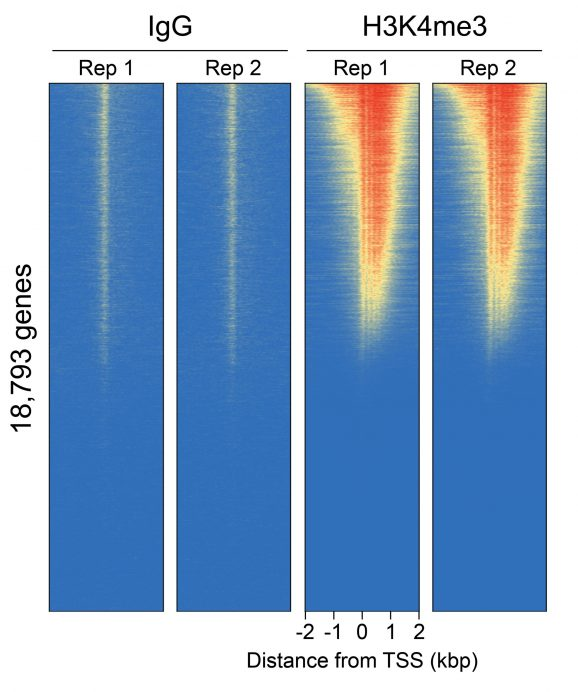
| Figure 3: CUT&Tag genome-wide heatmaps |
CUT&Tag was performed as described in Figure 5. Heatmaps show two replicates (“Rep”) of IgG and H3K4me3 antibodies in aligned rows ranked by intensity (top to bottom) relative to the H3K4me3 Rep 1 reaction. High, medium, and low intensity are shown in red, yellow, and blue, respectively. Antibodies to histone PTMs showed expected enrichment patterns and high reproducibility. H3K4me3, a marker of active transcription localized to transcription start sites (TSSs), shows enrichment consistent at TSSs, as expected. IgG shows low background enrichment. | |
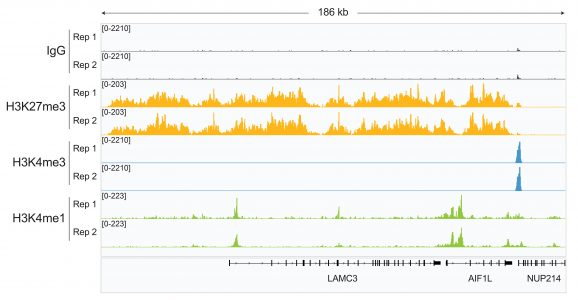
| Figure 4: Representative gene browser tracks |
CUT&Tag was performed as described in Figure 5. A representative 186 kb window at the LAMC3 gene is shown for two replicates (“Rep”) of IgG, H3K27me3, and H3K4me3 kit control antibodies. Representative tracks are also shown for two replicates of H3K4me1 antibody. The CUT&Tag kit produced the expected genomic distribution for each target. Images were generated using the Integrative Genomics Viewer (IGV, Broad Institute). | |
| Figure 5: CUT&Tag methods |
CUT&Tag was performed using the CUTANA™ CUT&Tag Kit starting with 100k K562 cells and 0.5µg of either IgG (EpiCypher 13-0042t), H3K27me3 (EpiCypher 13-0055t), H3K4me3 (EpiCypher 13-0060t), or H3K4me1 (EpiCypher 13-0057) antibodies. Libraries were run on an Illumina NextSeq2000 with paired-end sequencing (2x50 bp). Sample sequencing depth was 5.3/4.1 million reads (IgG Rep 1/Rep 2), 11.2/9.0 million reads (H3K27me3 Rep 1/Rep 2), 8.6/5.0 million reads (H3K4me3 Rep 1/Rep 2), and 4.1/10.3 million reads (H3K4me1 Rep 1/Rep 2). Data were aligned to the hg19 genome using Bowtie2. Data were filtered to remove duplicates, multi-aligned reads, and ENCODE DAC Exclusion List regions. |
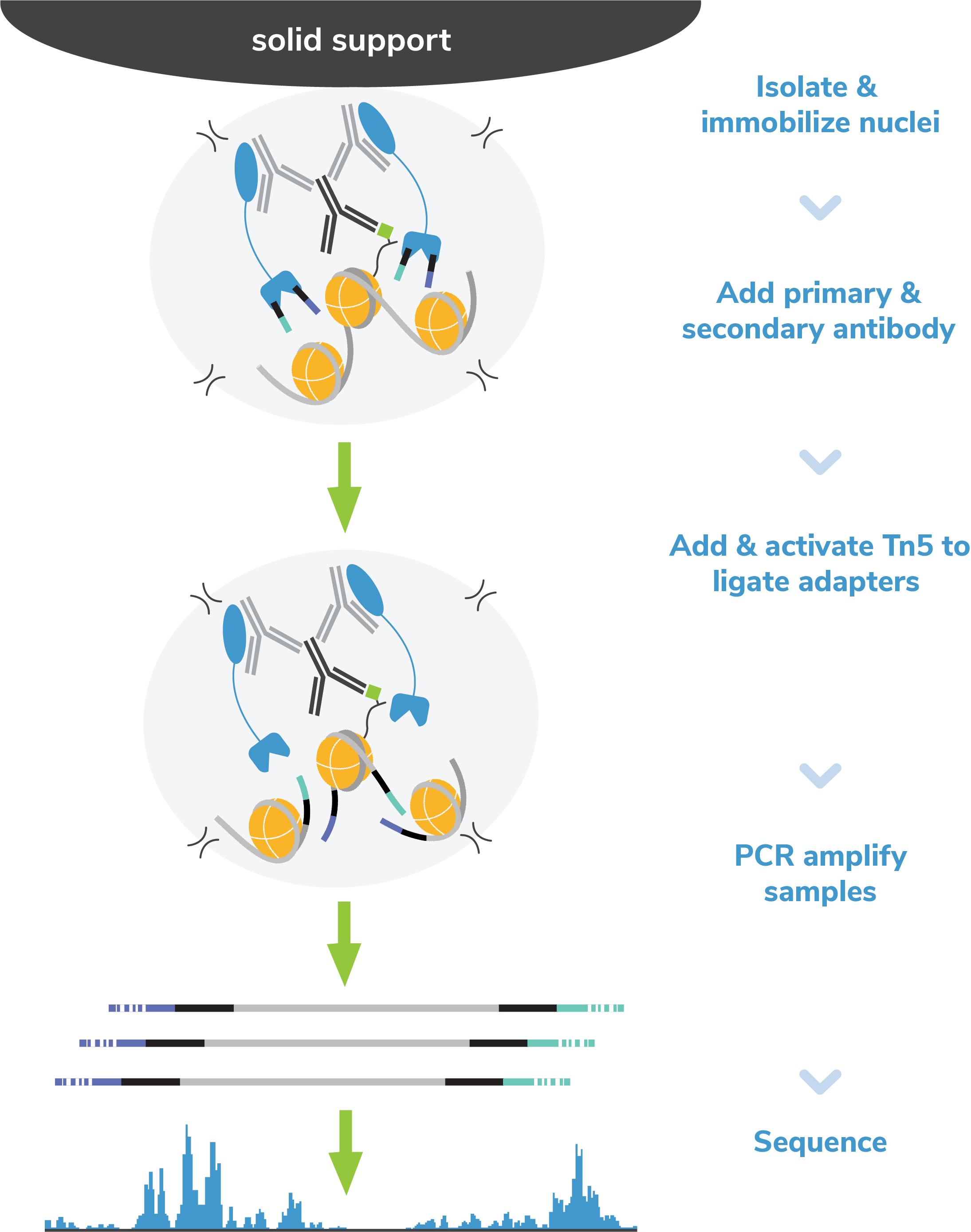
CUT&Tag技术有何特色?
精简化的工作流程跳过了传统ChIP-seq具有挑战性的步骤,包括染色质碎片和抗体下拉,用更少的细胞和测序读段生成高分辨率数据。
◆ 更短的实验周期
在两天内能够完成从细胞到文库的建立,而传统的ChIP-seq需要五天(或更长时间)。

◆ 更少的细胞需求量与更低的成本
CUTANA™CUT&Tag分析仅使用10000-100000个细胞核即可生成高分辨率的图谱,甚至可用于单细胞水平测序,便于单细胞或珍贵样本的分析;与传统ChIP-seq(需要约3000万次读取)相比,CUT&Tag检测仅需要500-800万次测序读段,节省实验成本。

◆ 更高的信噪比
CUTANA™CUT&Tag使用较少的起始细胞、更少的测序读段,也能得到较低的背景信号和较强的目的信号。
◆ 无需文库准备步骤
测序文库的准备工作既费时又昂贵。通过在抗体结合的目标位点添加测序适配器,能够实现跳过传统的文库准备步骤(end repair, adapter ligation),极大地简化了实验流程。EpiCypher的CUTANA™CUT&Tag分析通过直接从反应混合物中扩增标记DNA进一步简化了这一策略,实现在一个管中完成从细胞到PCR文库扩增。
EpiCypher还将dNuc™技术广泛的应用于多种分析测定产品中,包括:SNAP-ChIP®Spike-in Controls(用于抗体分析和ChIP定量), EpiDyne®底物(用于染色质重塑和抑制剂筛选及开发),dCyher™测定(用于探究表观遗传蛋白质-组蛋白PTM结合相互作用)。而且,EpiCypher还推出了针对ChIC、CUT&RUN和CUT&Tag的高灵敏度表观基因组图谱CUTANA™分析。


 复制QQ号成功,请打开QQ后添加好友进行咨询